© Parlamentsdirektion / Thomas Topf
Progress acknowledged, responsibilities challenged
The committee welcomed measures including the 2022–2030 national action plan and the new accessibility legislation. It also criticised differences between federal and provincial approaches and insufficient attention to the convention by provincial governments. Its central point was that the convention applies throughout a federal state. Domestic divisions of responsibility cannot justify failing to fulfil treaty commitments. The review therefore connected the national promises with decisions made by provincial administrations, rather than treating the existence of a federal plan as sufficient proof of compliance. [1][2]
Housing and support belong together
The recommendations called for a comprehensive strategy with benchmarks, deadlines and funding, developed with organisations of persons with disabilities. They linked ending institutionalisation with accessible housing and adequate personal, technical and financial support in the community. The committee also urged all provinces to participate in the personal-assistance harmonisation pilot. This combination is important: leaving an institution does not by itself create choice over where and with whom to live. The necessary support and housing have to exist together for independent living to become a practical option. [1]
Self-advocates demanded a different use of funds
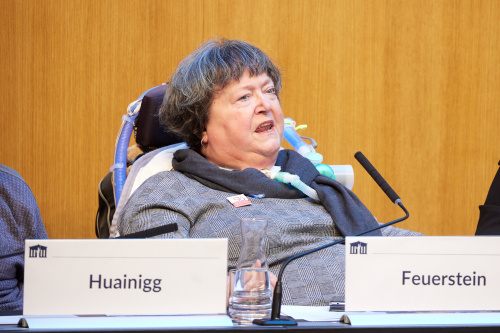
At a joint press conference on 11 September 2023, Bernadette Feuerstein of Selbstbestimmt Leben Österreich argued for shifting funding away from institutions towards individual community support, including personal assistance. Representatives of the Behindertenrat, the Austrian Ombudsman Board, the Disability Ombudsperson and the independent monitoring committee also participated. Their statements connected the UN process with domestic disputes over budgets, services and accountability. Feuerstein’s intervention was a self-advocacy demand for implementation, not an announcement that governments had already agreed to redirect the money. [3][4]
A dated benchmark for public decisions
Independent living and education were highlighted for urgent attention in the committee’s concluding observations. The document provides a benchmark for examining subsequent decisions about housing, assistance and schooling. Its chronology is clear: the dialogue took place in August, the recommendations were adopted on 4 September, and the formal document bears the date 28 September 2023. These are treaty-body recommendations following a country review, not a domestic court judgment or an automatic individual funding award. Their practical force depends on governments translating their obligations into legislation, budgets and services. [1][2]